Gone in 60 Seconds was a movie about car thieves, but it could just as easily describe bicycle thieves. Break the lock, ride away, end of story. For those looking to steal bikes, a university campus is a perfect place to do it. On the 窪蹋勛圖厙 campus last year, for example, 180 bicycles were stolen.
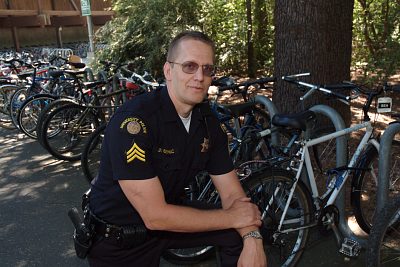
That���s why, when the 窪蹋勛圖厙 Police Department honored one of its own as Officer of the Year, they chose a man who was instrumental in recovering more than $15,000 worth of stolen bicycles. In fact, of 21 bicycles recovered last year, he recovered 20.
Doug Schulz, formerly a member of the detective unit (he���s now a sergeant managing one of the night patrol shifts) brushes aside kudos for the accomplishment, saying he had a lot of help and anyway, all he did was the basic legwork any good police officer will do.
What Schulz did was keep a list of every bicycle that was reported stolen, including the case number, the date and time of the theft, the make, model, serial number, color and anything unique about the bike.
���I tried to always have that list with me so that I could be on the lookout for bikes,��� Schulz said. ���Then when I was out and about, I would stop in pawn shops and bicycle shops to see if any of their bikes matched.���
A pawn shop, Schulz explained, has to hold a pawned bicycle for 90 days and report it to the local police department. A bike they buy outright also must be reported and must be held for 30 days. But Schulz didn���t wait for other police departments to discover their pawned bikes. Instead, he simply dropped by pawn shops and ask to see their inventory.
���I���d look at every single bike in the inventory and compare it to my list,��� Schulz said. ���Occasionally when I saw a bike that stood out, I���d run the serial number and find stolen bikes that weren���t 窪蹋勛圖厙 cases.���
It���s the more expensive bikes that wind up in pawn shops, Schulz said. Pawn shop owners, who know they are taking a risk that goods are stolen, might give only $300 for a $1,500 bike. The typical bike, worth less than $500, is more often sold on the street.
Expensive bikes also have been known to disappear from the University. In fact, at one point Schulz and his colleagues were looking for a bicycle worth more than $1,000 and got a tip from the Seattle Police Department. It turned out that the bike had been stolen by a prolific bicycle thief who had pawned his scores in shops from Mount Vernon to Olympia. The combined police effort netted 14 bicycles, including two from the 窪蹋勛圖厙.
Even with diligent police efforts, however, bike recovery isn���t usually high. Lower-priced bicycles that are sold on the street are usually recovered only by chance, Schulz said. But, he added, having the make, model and serial number of your stolen bike is essential if you ever hope to see it again. Photos are helpful too, as is a list of any unique features.
���The serial number is the most important thing,��� he said. ���If you don���t have it, you can sometimes get it after the fact from the bicycle shop where you bought it.���
He said he also pleads with bike owners not to scrimp on a lock. According to Schulz, bike owners should spend 10 percent of the value of their bicycle on a lock. In fact, he recommends two locks ��� a U lock and a good cable lock ��� and said both the bike���s frame and tires should be secured.
The riskiest time for bikes on campus is, of course, overnight. Schulz said 窪蹋勛圖厙 police officers do keep an eye out when they make their rounds, but they���ve caught would-be thieves with everything from portable power saws to blow torches, so they don���t recommend leaving your bicycle unattended all night.
With all the difficulties, Schulz said, it���s very rewarding when he does recover a bicycle. ���People say, ���It���s just a bike,��� but I know how much it can matter to people.���