
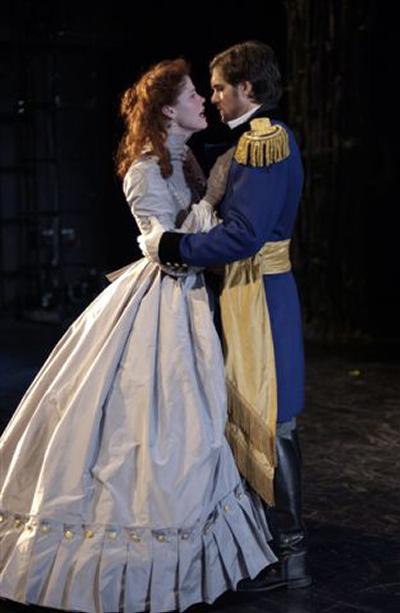
Directors have long felt free to alter the time and place of Shakespearean plays. Much Ado 窪蹋勛圖厙 Nothing set in 1920s New York, Julius Caesar in 1930s Germany, Romeo and Juliet in a modern, unspecified urban setting ��� they���ve all been done. So it���s not surprising that the School of Drama���s production of Macbeth, which opened last night, is set in America just after the Civil War.
But director Justin Emeka, a student in the master of fine arts program, has taken the changes one step further. He is deploying his multiracial cast ���to incorporate race and culture into the telling of the story.��� In his production, Macbeth is a ���fierce northern general��� a la Sherman, while Duncan, the king Macbeth murders, is a Lincolnesque figure hated by Macbeth���s southern belle wife. Macbeth���s rival Banquo is an African American soldier equal to Macbeth in merit who has been held back because of his race.
The point, Emeka says, is to go beyond so-called ���colorblind casting,��� a system that encourages the casting of non-white actors in roles traditionally played by whites without any alteration in those roles. Instead, Emeka ��� who is himself an African American ��� has cast black actors to play what he calls black roles.
The witches, for example, are newly-freed slaves. ���It���s after the war, but we���re at Lady Macbeth���s plantation, where she still has servants who function pretty much as slaves,��� Emeka explains. ���The witches have been abused and are searching for redemption and retribution through their African mysticism.���
In addition to casting African American actresses in the roles, Emeka has incorporated some African dance and cosmology, as well as capoeira, an Afro-Brazilian martial art.
Emeka said he was inspired to do his production after playing Edgar in an all-black production of King Lear at Yale Repertory Theater last year. That production was set in America 3,000 years before Columbus, and featured Avery Brooks (known to TV viewers as Captain Benjamin Sisko on Star Trek: Deep Space Nine) as Lear. According to Emeka, there is evidence of African kings in America during the Olmec civilization, so the production was organized around the idea that Lear was the last of these African kings, trying to maintain his legacy.
���It was a really innovative production that didn���t quite succeed,��� Emeka says. ���It had me excited but it didn���t work all the way, so it got me thinking ��� I like this idea; let me see if I can pursue it to see what I can find.���
Emeka chose Macbeth because he was attracted to its themes. ���The play to me is a lot about guilt and betrayal and a nation divided,��� he says. ���I was interested in the cost of betrayal, and in the question of how you undo a wrong.���
With that as background, the post-Civil War period seemed to make sense. Emeka began working on the text last summer, deciding how the characters would fit into the time period he���d chosen and making alterations in lines where necessary. He admits with a laugh that he wasn���t always sure his plan would work, but says that when he ran into difficulties he simply made ���bold choices, bold edits.���
Emeka says, ���At first you approach Shakespeare���s text as kind of sacred. You���re scared to cut or move anything.��� But the more he thought about it, the more he realized that Shakespeare is done so often, in such a variety of ways, that a single production is just one more contribution to an immense body of work. ���I had to get the confidence and courage to pursue my vision alongside the text and not think of just serving the text,��� Emeka says. ���I had to serve my vision with this text.���
Emeka says his cast of 19 ��� which includes both undergraduate and graduate students as well as community members ��� has been excited by his ideas and appreciative of the back story his vision has provided for their characters. So, has he succeeded in tranplanting a 16th century play set in Scotland to the 19th century American South? He���s not sure.
���It���s a pretty ambitious idea and I think if it works, it could really inspire a lot of people,��� he says. ���If it doesn���t work, it could confuse. Last week I was more worried about confusion; this week I���m leaning toward inspiration.���
But however it turns out, Emeka thinks it was worth doing, as an effort to go beyond colorblind casting.
���When colorblind casting began it was progressive, because it was letting people of color into the theater,��� he says. ���But really what you���re saying with that is, ���We���ll let you be white and act like you are just like everybody else.��� There���s something that���s kind of dehumanizing about that. This production for me was an experiment in saying, ���Let���s not just let black actors in; let���s incorporate their culture into the world, the telling of the story.���
He adds, ���I don���t think everybody has to do it, but I think it���s important that we know how if we want to.���
Macbeth will play through Feb. 13 in Meany Studio Theater. Tickets are $8���13, available at the Arts Ticket Office, 206-543-4880.