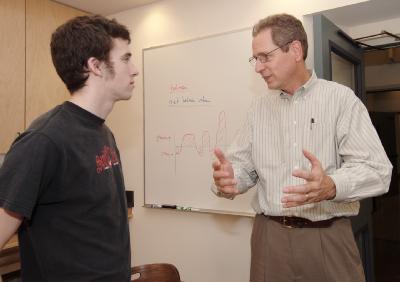
Where do brand-new freshmen and experienced professors come together to study questions obscure or obvious, entertaining or eternal, in a friendly and ungraded small-group format?
The answer ���Absolutely nowhere ��� you must be dreaming��� is wrong, actually.
But the answer ���The 窪蹋勛圖厙���s annual Freshman Seminars��� is correct.
Now in their 10th year, the Freshman Seminars are small, informal meetings held weekly throughout the school year that take up whatever topic the organizing professor wants to explore. The seminars are attended only by freshmen who choose to be there, bear a single credit and are not graded. But they are proving to be an excellent prologue for new students seeking to open their minds to the academic life, and for professors who feel renewed by direct student contact.
���The effort was to try and help undergraduates have substantive connections with faculty members. It happens for students eventually, but not always the first or second quarters,��� said Michaelann Jundt, director of the 窪蹋勛圖厙���s Carlson Leadership and Public Service Center, who coordinated the seminars until recently.
Roberta Hopkins, 窪蹋勛圖厙 director of classroom support services and interim director of first year programs, who now oversees the seminars, had similar praise. ���For students coming here for the first time, it���s a fabulous way to feel connected to faculty in a small, intimate setting,��� she said.
But the good stuff isn���t only for the students ��� it seems to go both ways. Mary Pat Wenderoth, a senior lecturer in the biology department who has held several seminars, said, ���It���s refreshing to see freshmen and realize you are helping them figure out what they like, and you get to give them a little of your passion about your discipline.��� She added with a laugh, ���And it���s so nice to be in a class where you don���t have to grade.���
Steven Tanimoto, a professor of computer science, is teaming this quarter with Daryl Lawton, a visiting scholar recently retired from Microsoft, to teach a seminar on the computer programming language Python. Tanimoto said such seminars are a break from the more ambitious, competitive ��� and therefore more stressful ��� programming classes. The more curriculum is defined by departmental decisions, he said, ���the more anxious a faculty member is to have an environment where one can interact a little less formally with students.���
Tanimoto said his seminars usually are taught in the computer labs, and often use an online conferencing program, ���so we can all play around with these new tools.���
The seminars also can open students up to subjects they hadn���t previously considered or which don���t fit in their largely pre-arranged college plans. Tamara Moats, curator of education for the Henry Art Gallery, has seen this among students she has led in freshman seminars dipping into the vast art resources of the gallery.
���I���ve had many students come up and say, ���I had no idea you could do this sort of exploration with art. I never liked looking at art before, and I can see how you make this a personal experience,������ Moats said. She said students have told her, ������This is the only art history class I will get to take, and I���m thrilled.������
Philosophy Professor William Talbott said he usually meets freshmen in huge lecture courses ��� this quarter���s lecture has 185 students ��� and that it���s a pleasure to have the smaller, more informal environment of the seminars.
���The Freshman Seminars are a lot of fun,��� he said. ���I particularly like teaching them in autumn quarter, when (the students) are just getting to the U for the first time, discovering so much. And they���re enthusiastic.���
Talbott uses the seminars to open young minds to some of the eternal questions of life. He said a good starting question often is, ���What is philosophy?��� His own quick definition seemed nicely appropriate for new scholars to ponder: ���It begins when people stop relying on authorities and decide they will trust their own judgment, and think for themselves,��� he said.
Tanimoto, Moats and others say they have had students who have gone on to show talent in the field they explored in the seminars. ���Sometimes it���s the beginning of a relationship between the students and faculty that can last a long time,��� Tanimoto said.
The Freshman Seminars mean some extra, unpaid work for faculty and more classroom time for students, but the rewards seem great, on both sides of the bargain.
Hopkins, who now oversees the seminar process, said, ���We want the university experience to be one of personal connections, even at a very large institution.���
She added, ���If I were a freshman and had one of these opportunities, I���d be all over it.���