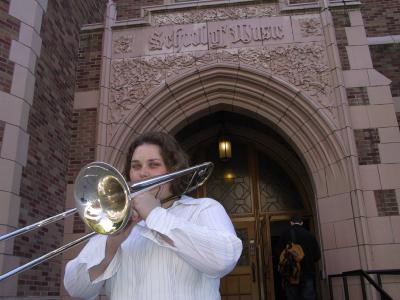
Kelly Clingan, who is majoring in both Women Studies and Music Education, has found the perfect way to combine her interests: she is conducting an all-girl jazz band in a performance of music composed or arranged by women.
The free performance will take place at 7:30 p.m. Thursday, May 22 in Brechemin Auditorium in the Music Building. The 18-piece band, called ���New Girls on the Block,��� is composed of musicians from six of the area���s high schools and has been rehearsing weekly since February. Their performance, a Women Studies thesis project, includes Clingan���s first original composition.
���In high school jazz band (Roosevelt in Seattle), I was one of two girls in the band, and we never played compositions by women,��� she says.
When Clingan���s idea was approved by her Women Studies thesis advisor, associate professor Angela Ginorio, she began recruiting players, going from high school to high school, picking up a drummer here and a trombone player there. ���The girls were really excited at the prospect of playing jazz in an all-girl band. They realized that rehearsing once a week, plus sectionals every other week, was a big commitment, but it meant a lot to them.���
After recruiting the band, Clingan���s next, and biggest, challenge was finding jazz compositions by women. She went with her other thesis advisor, assistant professor of Jazz Studies Vern Sielert, to the 窪蹋勛圖厙 music library and found just three selections by women. ���One I didn���t like and another was just too hard,��� she says. So the search continued. She found an additional chart in the library at Roosevelt High School. A classmate of Sielert���s from North Texas State volunteered another. A friend of Clingan���s trombone teacher, when she heard about the project, composed an original piece just for the ensemble. ���I should have paid her a lot for that. But I���m a student, I don���t have any money.���
She picked up additional songs and then sat down to compose her own piece ��� a requirement for her thesis project. ���It was a huge undertaking. I didn���t realize what I was getting into. But I���m pleased with it.���
For the band members, this was a very different experience than in their school jazz bands, where pieces are rehearsed day after day for many months. ���This is valuable for those thinking of a career in music, where you have to be able to get to performance level quickly,��� Clingan says.
For some of the girls, this was their first opportunity to solo, and most of them were hesitant. They were given a pep talk by one of the girls, an accomplished soloist at Garfield High School, who told them how scary it was the first time, but how much she enjoyed it and how much better she got as a result of putting herself out front.
Clingan���s goals were not simply to stage an all-girl performance. ���I wanted to empower the girls and to create a sense of community, so that after this, when they see one another at festivals, they encourage and support one another. I tried to create a nurturing environment in rehearsals, more nurturing than is the case in most high school jazz programs.���
Clingan notes that in middle school jazz programs the sexes are about equal in number, but there is a large disparity in high school, often because girls don���t even audition for the band. She would like to write a grant to fund a summer program for girls in eighth grade who want to play jazz, to create a bridge of support and encouragement between middle school and high school.
���This has been great fun,��� she says. ���I was actually able to see some of the girls blossom in this environment.���