Editor���s note: This is part of our blog series, ���,��� investigating the impact of hazing laws in states that require public disclosure of hazing incidents.
At least 21 hazing incidents have been publicly reported by 5 Washington colleges and universities since 2018 ��� but experts say that number is low and doesn���t reflect the true scope of hazing on the state���s college campuses.
One reason: Only 35% of Washington colleges and universities are in compliance with a state law that requires all public and private schools to disclose campus hazing cases on their websites.
A new����investigation finds 20 out of 31 higher education institutions in Washington are not disclosing hazing incidents despite a legal requirement to do so.
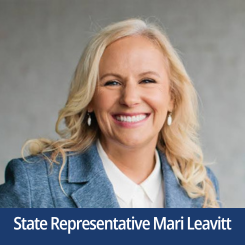 State Representative Mari Leavitt calls that figure unacceptable. She led the passage of ��in 2022, which requires transparency about campus hazing incidents.
���Hazing doesn���t stop because we pass a law, obviously,��� Leavitt said. ���It���s discouraging to hear about the ones not complying. They know better. Clearly, more work needs to be done.���
Leavitt has called for a work session on Sam���s Law to better understand how institutions are implementing the law.��That session is����for Wednesday, April 2, at 1:30 pm in front of the House Postsecondary Education and Workforce Committee.
11 Washington campuses report hazing as required
Washington���s law was named after Sam Martinez, a Washington State University freshman who��of alcohol poisoning following a hazing ritual at Alpha Tau Omega fraternity.
Sam���s family partnered with Leavitt to pass Sam���s Law in 2022 and a second bill in 2023 that made hazing a felony in Washington.
Washington college hazing data, 2018 to February 2025
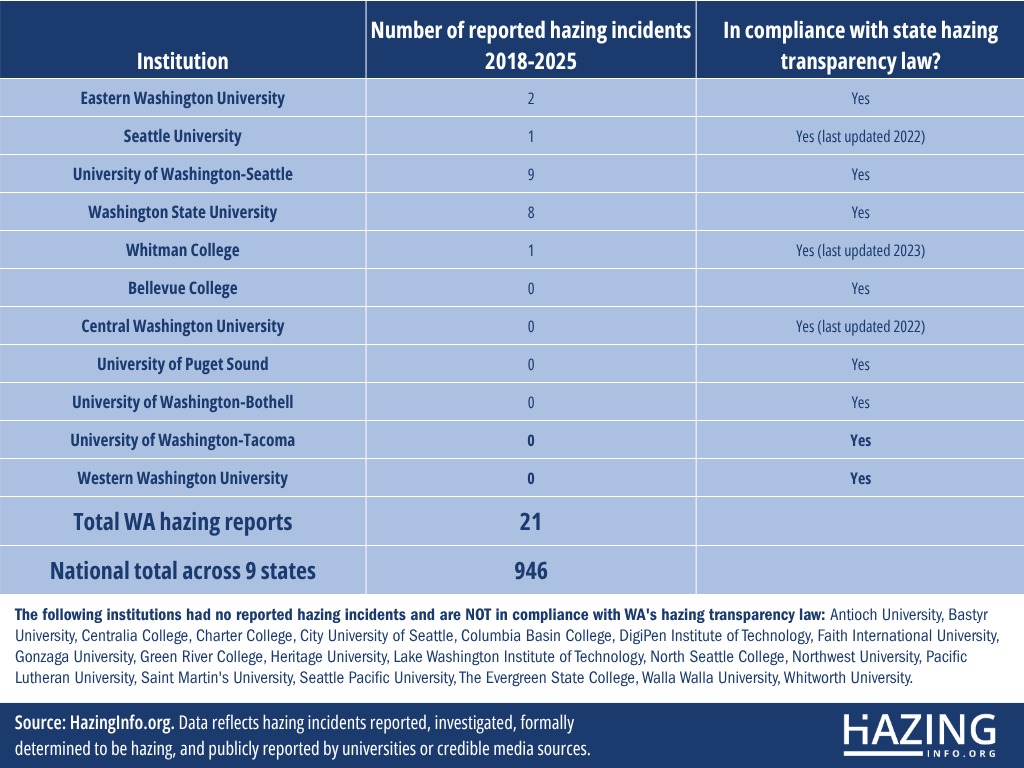
Across the nation, the����found 946��reported incidents of hazing on 171��campuses between 2018 and February 2025. That total only reflects data from the nine states, including Washington, that currently require public reporting of hazing incidents.
HazingInfo found 11 Washington colleges and universities that make their hazing data available publicly as required:��;泭;泭;泭;泭; all three 窪蹋勛圖厙 campuses (,泭, and��);泭;泭; and��.
The HazingInfo investigation did not include other kinds of organizational misconduct like alcohol violations or assaults that weren���t officially labeled as hazing.
Five of Washington���s 31 colleges and universities don���t even have a formal hazing policy, while 14 campuses do not have an online reporting form for students and others to report hazing.
���They know who the bad organizations are���
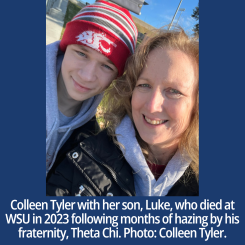 Colleen Tyler calls it unconscionable that so many campuses are still not reporting hazing. Her son, Luke, died by suicide at Washington State University in 2023 after he endured ��by his fraternity, Theta Chi.
���It���s not just physical, it���s the mental anguish they���re putting these kids through in the name of brotherhood. And it���s sickening,��� Colleen Tyler said.
After her son died, Tyler heard from a couple dozen people with their own stories about hazing they experienced or witnessed at Washington State University and beyond.
���I just don���t know what else it���s going to take to change,��� Tyler said. ���It���s a felony, you have to report it now, and yet ��� the schools are almost complicit in it. They get the police reports, they know who the bad organizations are, they know the patterns.���
Schools tell parents they are ���all about campus safety,��� she said. ���Your words have to match your actions. You can���t tell us you care about the kids and then not report on hazing.���
More hazing awareness means more reports of hazing
At the 窪蹋勛圖厙 (窪蹋勛圖厙), hazing reports are up since the passage of Sam���s Law. Alex Salemme calls that a good sign.
���To us, that means the education and the awareness are working,��� said Salemme, 窪蹋勛圖厙���s hazing prevention and response specialist.
窪蹋勛圖厙 has received 13 reports of hazing so far this academic year, he said ��� nearly the same as for all of 2023-24. But not all hazing reports are substantiated after an investigation.
The state���s flagship university has publicly reported nine hazing incidents since 2018, the largest number in the state. Those are incidents that have been investigated, formally determined to be hazing, and included in the��窪蹋勛圖厙���s hazing transparency report.
Washington State University (WSU) has publicly reported eight hazing incidents since 2018.
In a recent presentation to the state Legislature, WSU reported a total of 52 violations of student organization policies (including hazing) since 2023. Of those:
- 38 cases were dismissed for insufficient evidence.
- 7 cases had charges dropped.
- 4 are pending investigation.
- 1 organization was found not responsible.
- 2 organizations were found responsible.
First Pacific Northwest Anti-Hazing Summit planned for June
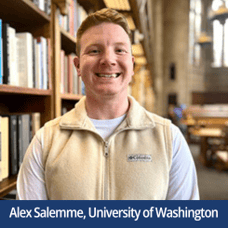 Salemme���s role is itself an outgrowth of Sam���s Law. The 窪蹋勛圖厙 created the position following the law���s passage.
Sam���s Law has ushered in other changes at 窪蹋勛圖厙, including:
- Annual training for all staff and faculty on hazing prevention.
- New programs, workshops, and presentations about hazing aimed at all students.
- A new cross-campus commitment to hazing prevention that includes student leaders, health educators, student activities staff, the athletics department, and resident advisers.
���We have good buy-in, and it needs to be a campus-wide approach and getting everybody on the same page to change the culture,��� Salemme said. ���We still have a long way to go, it���s not perfect. But there���s a lot of positive momentum.���
Not every Washington campus has the resources to dedicate a full-time staff position to hazing prevention like the 窪蹋勛圖厙, Salemme said. At smaller schools, it may not be clear whose job it is to oversee hazing reporting and prevention activities.
Salemme said he has worked to position 窪蹋勛圖厙 as a leader in hazing prevention across the nation. On June 24, 窪蹋勛圖厙 will host the first��Pacific Northwest Anti-Hazing Summit��for campus professionals from 10 Western states. More than 60 people have registered to attend.
Prevention means so much more than ���We don���t haze���
 Eastern Washington University (EWU) in Cheney, WA, has also seen an increase in hazing reported by students since Sam���s Law went into effect. The school has publicly reported two hazing incidents since 2022 in its .
Sam���s Law has led to other changes in EWU’s response to hazing, said Elise Brehmer, EWU���s assistant director for sorority and fraternity life.
As part of her hazing prevention work with students, Brehmer said she often shows����featuring Sam Martinez���s family discussing his hazing death with reporter Anderson Cooper.
���When I think of prevention, it���s so much bigger than just ���We don���t haze,������ Brehmer said. ���It can���t just be a one-off workshop. Our approach is ��� how are we building healthy organizations and students so they know how to identify unhealthy behaviors and they���re not perpetuating those behaviors.���
啦堯梗泭��under Sam���s Law has helped EWU focus on a broader range of behaviors that can be considered hazing, she said, and the school���s new Hazing Prevention Committee required by the law means ���it���s not just me alone working on this��� but part of a more comprehensive campus approach, she said.
She also appreciates that sororities and fraternities must now notify the university if they initiate a hazing investigation, information that wasn���t always shared in the past.
An unintended consequence of the law: Less oversight?
It remains challenging to get students to report hazing for fear of being ostracized or getting themselves or other students in trouble, Brehmer said.
Organizations found responsible for hazing may lose their recognition by the university, meaning they can���t formally recruit new members or operate with the approval and backing of the university.
Those organizations may end up with less oversight, even while some continue to operate informally.
���In practice, that has taken away some of our ability to provide corrective action immediately,��� Brehmer said. ���We don���t want to deter students from reporting it or hiding those behaviors, and we don���t want organizations to exist that jeopardize student safety.���
Overall, Brehmer said she feels encouraged about the conversations on hazing prevention that are happening now, especially with the recent passage of the federal Stop Campus Hazing Act requiring all US colleges and universities to publish a����on their websites by December.
���We���re not there yet. There���s still under-reporting occurring. But I think we���re moving in the right direction,��� she said.
Source: Houtz, J. (2025, March 31). 21 hazing incidents since 2018: The state of hazing in Washington. hazinginfo.org. April 15, 2026, https://hub.hazinginfo.org/blog/state_of_hazing_washington
 The 窪蹋勛圖厙 is pleased to host the 2026 PNW Anti-Hazing Summit on July 15, 2026. This one-day virtual professional development welcomes individuals from across the region for a day of learning and growth on best practices and strategies for hazing prevention, investigation, and implementation of the Stop Campus Hazing Act.
 Sam���s Law also known as House Bill 1751, was sponsored by Representative Mari Leavitt of the 28 Legislative district and proposed to the Washington state Legislature by Jolayne Houtz and Hector Martinez after their son Sam���s death in November 2019 at the Washington State University (WSU) Pullman campus.��Sam Martinez died due to alcohol poisoning caused by his fraternity brothers of Alpha Tau Omega who hazed him into taking the ���frat���s pledge��� in which Sam and other freshmen were required to drink large amounts of alcohol.
 窪蹋勛圖厙 defines hazing as ���any act committed as part of a person���s recruitment ��� that is likely to cause, bodily danger or physical harm, or serious psychological or emotional harm, to any student.���